The short answer: 0DTE means zero days to expiration: options that expire the day you trade them. The most common SPX 0DTE strategies are iron condors and credit spreads, which collect premium and profit if SPX stays away from the short strikes until the 4:00 p.m. ET close, and butterflies, which cost little and pay off if SPX finishes near a target. Time decay works fast on the last day, but so do losses: a modest move late in the day can turn a winning trade into a maximum loss.
On this page
- What 0DTE means
- Time decay on the last day
- Strategy 1: the iron condor
- Strategy 2: a one-sided credit spread
- Strategy 3: the butterfly
- The other side: gamma risk
- Choosing strikes
- Managing a 0DTE trade
- Risks to know
- 0DTE with a smaller account: XSP
- Combining SPX and XSP positions
- Frequently asked questions
What 0DTE means
A 0DTE option has zero days to expiration: it expires at the end of the day you trade it. SPX has had an expiration every weekday since 2022, so there is a same-day contract every trading day. These daily options (root symbol SPXW) stop trading at 4:00 p.m. ET and settle in cash on the index's closing value.
0DTE trading has grown into the main event in SPX. In July 2026, same-day options reached a record 66% of all SPX options volume, according to Cboe. Traders use them to make a defined-risk bet on a single day's move without holding anything overnight.
New to the building blocks? Read SPX credit spreads: how they work first; every strategy below is built from the same pieces.
Time decay on the last day
An option's time value melts toward zero by expiration, and on the last day it melts fast. The table follows the iron condor from the example below, with SPX sitting still at 7,800 all afternoon:
| Time left | Value of the iron condor | Seller's profit so far |
|---|---|---|
| 6 hours (sold at $2.55) | $2.55 | $0 |
| 4 hours | $1.64 | +$91 |
| 2 hours | $0.51 | +$204 |
| 1 hour | $0.06 | +$249 |
SPX at 7,800, priced with a simple model that uses 15% implied volatility at every strike, before commissions. Real 0DTE prices and volatility change through the day.
That steep decay is why sellers like 0DTE. But it only works if the market cooperates, and the same speed applies to losses, as the gamma section shows.
Strategy 1: the iron condor
An iron condor sells a put spread below the market and a call spread above it. It collects premium from both sides and keeps it if SPX finishes between the short strikes.
Example: SPX is at 7,800 with six hours to the close. The expected move for the rest of the day is about ±31 points, so you sell the 7,770 put and the 7,830 call, about one expected move away, and buy the 7,760 put and 7,840 call as protection. The whole condor collects $2.55, or $255.
| Number | How it's worked out | Result |
|---|---|---|
| Max profit | The credit, if SPX closes between 7,770 and 7,830 | $255 |
| Max loss | Wing width minus credit: (10 − 2.55) × $100 | $745 |
| Breakevens | 7,770 − 2.55 and 7,830 + 2.55 | 7,767.45 and 7,832.55 |
| Probability of profit | Chance SPX closes between the breakevens, in the model | About 71% |
Hypothetical prices from the same 15% volatility model, before commissions.
The shape is typical of 0DTE premium selling: you win most days, but one losing day can cost about three times what a winning day makes. Open this iron condor in our free calculator to see its risk graph and try other strikes.
Strategy 2: a one-sided credit spread
If you have a view on direction, you can sell just one side. In the same setup, the 7,770/7,760 put credit spread collects about $1.25 and profits if SPX stays above 7,768.75 at the close, which the model puts at about 85%. It risks up to $875.
One side means less premium than a condor but no risk from a rally; a call credit spread does the reverse. Either way, the loss can be several times the credit. For how strikes, width and settlement work, see our SPX credit spreads guide.
Strategy 3: the butterfly
A butterfly is the opposite kind of trade: you pay a small debit for a big payoff if SPX finishes near a target. A call butterfly buys one call below the target, sells two at the target and buys one above it.
Example: the 7,790/7,800/7,810 call butterfly costs about $1.30, or $130. If SPX closes exactly at 7,800, it's worth $10, a profit of $870. It makes money if SPX closes between 7,791.30 and 7,808.70, which the model puts at only about 22%, and the most you can lose is the $130 you paid.
Butterflies flip the usual 0DTE trade-off: you lose small most of the time and occasionally win big. Some traders combine them with condors to add a profit peak in the middle of a wider range.
The other side: gamma risk
Near expiration, option prices react sharply to small moves; traders call this high gamma. A move that would barely matter a month out can decide a 0DTE trade. The table shows the example iron condor (sold for $2.55) after SPX drops:
| What happens | Value of the iron condor | Seller's result |
|---|---|---|
| SPX unchanged, 2 hours left | $0.51 | +$204 |
| SPX down 20 points, 2 hours left | $2.02 | +$53 |
| SPX down 30 points, 2 hours left | $3.90 | −$135 |
| SPX down 45 points, 1 hour left | $7.83 | −$528 |
Same 15% volatility model, before commissions. In a real sell-off, implied volatility usually rises too, which makes the losses larger.
A 45-point drop is less than 0.6% of the index, a move SPX can make in a single afternoon. That is the real risk in 0DTE selling: not the average day, but the day the market moves.
Choosing strikes
- Use the expected move. It shrinks as the day goes on: about ±31 points with six hours left in the example, about ±18 with two hours left. Strikes inside it collect more but are tested more often. Our calculator shows the expected move for any time left.
- Watch the delta. The short option's delta is roughly the chance it finishes in the money. Many 0DTE sellers use short strikes with low deltas, giving up premium for a higher win rate.
- Mind the width. Wider wings collect more and risk more. Narrow wings keep the dollar risk small, but commissions take a larger share of a small credit.
- Check the calendar. Fed decisions, inflation reports and jobs data can move SPX far more than a normal day's expected move.
Managing a 0DTE trade
- Decide your exits before you enter. Common approaches are taking profits at a set share of the credit, for example half, and exiting if the loss reaches a multiple of the credit or SPX touches a short strike.
- Size for the bad day. Assume the maximum loss will happen sometimes and keep it to an amount you can afford.
- Use limit orders. 0DTE prices move quickly, and multi-leg orders can fill far from the midpoint in a fast market.
- Think about the last hour. SPX 0DTE options settle in cash on the close automatically, so you don't have to act. But the final minutes are when small moves swing prices most, and many traders close or reduce positions before then.
- Use the daily contracts. On the third Friday of the month, the standard monthly SPX options are AM-settled and stopped trading the day before. 0DTE traders use the PM-settled daily contracts (SPXW). More on AM and PM settlement.
Risks to know
- Losses are bigger than gains. For premium sellers, one maximum loss can erase several weeks of wins.
- Speed. A position can go from comfortable to maximum loss in minutes, faster than many traders can react.
- Volatility spikes. Sudden news can lift implied volatility and widen bid-ask spreads exactly when you want to exit.
- Overtrading. A fresh contract every day makes it easy to trade too often and too large.
Read the Options Clearing Corporation's Characteristics and Risks of Standardized Options if you haven't, and keep each position small enough that its worst case is affordable.
0DTE with a smaller account: XSP
XSP, the Mini-SPX index, also has expirations every weekday and is one tenth the size of SPX. The same iron condor on XSP, the 776/777/783/784 condor, collects about a tenth of the credit and risks about $75 instead of $745. Same-day trading has become most of XSP's volume as well. The trade-offs are lower liquidity and higher commissions per dollar of exposure; SPX vs XSP compares them in detail.
Combining SPX and XSP positions
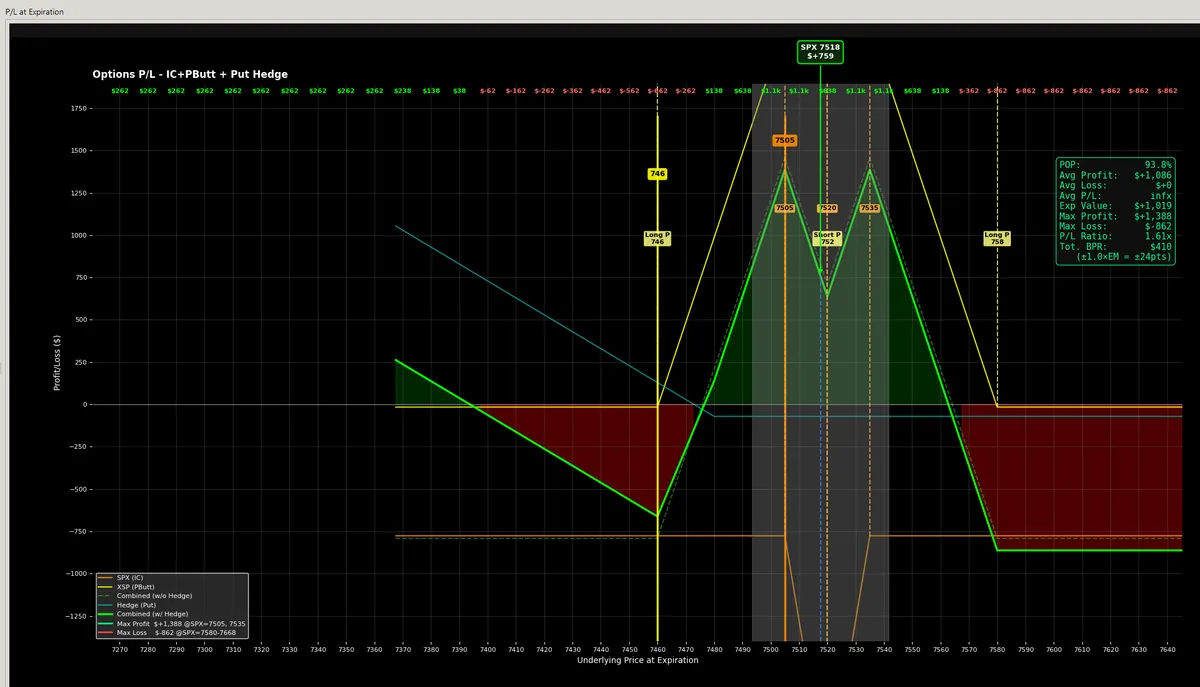
Many 0DTE traders put the main position on in SPX and fine-tune it with XSP: a few XSP puts as a crash hedge under an SPX iron condor, or an XSP butterfly to add a profit peak. Seeing what the combination does is hard, because most platforms show each position separately. The SPX-XSP Risk Graph Visualizer plots them together, with the combined profit and loss at expiration and the expected move. Watch a 2½-minute example: The Marriage of SPX to XSP.
Frequently asked questions
What does 0DTE mean?
Zero days to expiration: options that expire on the same day you trade them. SPX has an expiration every weekday, so there is a 0DTE contract every trading day.
When do SPX 0DTE options expire?
Daily SPX options (root symbol SPXW) stop trading at 4:00 p.m. ET on expiration day and settle in cash on the index's closing value.
Why are iron condors popular for 0DTE?
An iron condor collects premium from both a put spread and a call spread and keeps it if SPX stays between the short strikes until the close. With only hours left, that premium decays quickly. The catch is that the maximum loss is several times the credit, and a fast move late in the day can reach it.
How much can I lose on a 0DTE iron condor?
The width of one side minus the total credit, times $100. The example in this article, with 10-point wings and a $2.55 credit, can lose up to $745 per iron condor before commissions.
Can I trade 0DTE with a small account?
XSP, the Mini-SPX index, also has daily expirations and is one tenth the size of SPX, so the same iron condor risks about a tenth as much. Commissions take a bigger share of the smaller credit, so check your broker's costs.
Do I have to close 0DTE trades before the close?
No. SPX options settle in cash automatically, so out-of-the-money options simply expire. Many traders still close or reduce positions before the last minutes, when prices react most sharply to small moves.
Test a 0DTE trade before you place it
Enter your strikes, credit and the hours left in our free calculator to see the max profit and loss, breakevens, probability of profit and the expected move for the rest of the day.
Sources
- Cboe, Trading Volume for July 2026: 0DTE share of SPX volume.
- Cboe, SPX Options Product Specifications: daily expirations, trading hours and settlement.
- Cboe, Derivatives September 2026 Volume Highlights: XSP 0DTE volume.
- Options Clearing Corporation, Characteristics and Risks of Standardized Options: how options strategies work, and their risks.
This article is for education only and isn't financial or tax advice or a recommendation to trade. Example prices are hypothetical and come from a simplified model. Options involve substantial risk and aren't suitable for every investor; same-day options can lose value very quickly. See our Risk Disclaimer.