The short answer: XSP (Mini-SPX) options are one tenth the size of SPX options and otherwise work almost the same way. Both are European-style and cash-settled, both expire every weekday, and both get 60/40 tax treatment in the US. SPX is usually cheaper and more liquid once your position is the size of one SPX contract or more. XSP is better for smaller positions and for adjusting size in small steps.
SPX vs XSP at a glance
| Feature | SPX | XSP (Mini-SPX) |
|---|---|---|
| Underlying | S&P 500 index | S&P 500 index ÷ 10 |
| Multiplier | $100 | $100 |
| Size with the S&P 500 at 7,800 | $780,000 per contract | $78,000 per contract |
| Strike spacing near the money | Usually 5 points | Usually 1 point (10 SPX points) |
| Exercise | European: at expiration only | European: at expiration only |
| Settlement | Cash. Third-Friday monthlies are AM-settled; all other expirations (SPXW) are PM-settled | Cash. All PM-settled |
| Expirations | Every weekday, plus monthly and longer-dated | Every weekday, plus monthly and longer-dated |
| Trading hours | Regular, after-hours (curb) and overnight sessions | Same as SPX |
| US tax treatment | Section 1256: 60% long-term, 40% short-term | Same as SPX |
| Liquidity | Among the most traded options in the world | Much smaller, but growing fast |
| Best for | Larger positions and the lowest cost per dollar of exposure | Smaller accounts, fine-tuning size and partial hedges |
Contract size: 1 SPX = 10 XSP
XSP is based on one tenth of the S&P 500 index. With the S&P 500 at 7,800, XSP is at 780. Both contracts use a $100 multiplier, so one SPX contract represents $780,000 of index exposure and one XSP contract represents $78,000.
Option prices scale the same way. Suppose an SPX 7,800 call is trading at $60.00, which costs $6,000 for one contract. The XSP 780 call with the same expiration will trade near $6.00, or $600. Ten of those XSP calls give you about the same position as one SPX call.
Rule of thumb: divide SPX strikes and option prices by 10 to get the XSP equivalent, and multiply the number of contracts by 10.
Position sizing and spread risk
For spread traders, size shows up as risk per spread. The most you can lose on a vertical credit spread is the distance between the strikes, times $100, minus the credit you collected. Here's the same trade on both, before commissions:
| Put credit spread | Width | Example credit | Max loss |
|---|---|---|---|
| SPX 7,600 / 7,590 | 10 points | $2.00 ($200) | $800 |
| XSP 760 / 759 | 1 point (10 SPX points) | $0.20 ($20) | $80 |
Both spreads cover the same stretch of the index, so one SPX spread is about ten XSP spreads. What changes is the size of each step. On SPX the smallest practical unit of risk is several hundred dollars; on XSP it's under $100. That helps when you:
- Have a smaller account and want each trade to be a small share of it.
- Scale in or out of a position a little at a time.
- Hedge part of an SPX position, for example with three XSP puts, which works like 0.3 of an SPX put.
- Test a new strategy with real money but small size.
One trade-off: XSP strikes are usually 1 point apart, which is 10 points in SPX terms, while SPX strikes are usually 5 points apart. If you need precise strike placement, SPX gives you the finer grid.
To run your own numbers, with probability of profit and a risk graph, try our free SPX & XSP options calculator. New to credit spreads? Start with our SPX credit spreads guide.
Exercise and settlement
Both SPX and XSP options are European-style: they can only be exercised at expiration. A short SPX or XSP option can't be assigned early, which removes a risk that comes with stock and ETF options.
Both are also cash-settled. At expiration, an in-the-money option pays the difference between its strike and the settlement value in cash. No shares change hands, so you never end up holding stock you didn't plan for.
AM vs PM settlement
This is where the two differ:
- Standard monthly SPX options (third Friday, root symbol SPX) are AM-settled. Their last trading day is Thursday, and the settlement value (symbol SET) is calculated from the opening prices of the S&P 500 stocks on Friday morning. If the market gaps overnight, settlement can land far from Thursday's close, and there's no way to trade out of it.
- All other SPX expirations (root symbol SPXW), including the daily options, are PM-settled. They trade until 4:00 p.m. ET on expiration day and settle on the index's closing value.
- XSP options are all PM-settled, so AM settlement never comes into play.
If you trade SPX around the third Friday of the month, check whether your contract is SPX or SPXW. Most platforms show the root symbol in the option chain.
Expirations, 0DTE and trading hours
Since 2022, both SPX and XSP have had expirations every weekday, Monday through Friday. That's what makes same-day (0DTE) trading possible on either one, alongside weekly, monthly and longer-dated contracts.
Both also trade almost around the clock on weekdays. Besides regular hours (9:30 a.m. to 4:15 p.m. ET), Cboe runs a short after-hours "curb" session and an overnight session called Global Trading Hours. Not every broker offers every session, so check yours before you plan on trading outside regular hours.
Taxes: the 60/40 rule
For US taxpayers, SPX and XSP are taxed the same way. Both are broad-based index options, which the tax code treats as Section 1256 contracts:
- 60/40 split: 60% of your gain or loss counts as long-term and 40% as short-term, no matter how long you held the position. That applies even to a trade you opened and closed the same day.
- Marked to market at year-end: positions still open on the last business day of the year are taxed as if you sold them at that day's price.
- Separate reporting: your broker lists them in their own section of your 1099-B, and they go on IRS Form 6781.
At the top federal brackets (37% short-term, 20% long-term), that works out to a maximum blended rate of 26.8% on Section 1256 gains, compared with up to 37% on short-term gains from SPY or stock options. The 3.8% net investment income tax can apply to both. None of this matters inside an IRA or other tax-advantaged account.
Because the treatment is identical, taxes aren't a reason to pick SPX over XSP, though they can be a reason to pick either one over SPY. This is general information, not tax advice, so check with a tax professional about your own situation.
To see the difference on your own numbers, use the 60/40 tax comparison in our calculator. It's a simplified estimate, not tax advice.
Liquidity and trading costs
Low volume and wide bid-ask spreads are the main reasons many traders skip XSP, and for years that reputation was deserved. Apart from a burst in 2019, XSP traded fewer than 50,000 contracts a day, and in 2021 fewer than 20,000, while SPX traded well over a million.
That has changed quickly since 2022, when Cboe gave XSP daily expirations and overnight trading. XSP averaged about 115,000 contracts a day in 2025, and 2026 has brought one record after another, the latest being 274,000 a day in September. Daily volume is now about ten times what it was in 2021, and in recent months roughly 60% of it has been same-day (0DTE) trading.
XSP options: average contracts traded per day
More volume usually means more market makers competing for orders and tighter quotes, and Cboe runs an incentive program for XSP market makers that meet stricter quoting standards. Still, XSP is much smaller than SPX, which trades roughly 25 times as many contracts, each ten times bigger. That difference shows up in two places:
- Bid-ask spreads. SPX spreads look wider in dollars but are narrower relative to the size of the position. On XSP the spread is often a bigger share of the option's price, and when you need ten XSP contracts to match one SPX contract, you pay that spread ten times.
- Commissions and fees. Brokers charge per contract, so matching one SPX contract with XSP means paying ten commissions. At $0.65 per contract, that's $6.50 instead of $0.65 each way. SPX usually carries higher exchange fees per contract, which narrows the gap but rarely closes it.
So once your position is the size of one SPX contract or more, SPX is usually the cheaper way to trade it. Below that, XSP is what lets you trade it at all. Either way, use limit orders, especially for multi-leg XSP orders.
What about SPY options?
SPY options are options on the SPDR S&P 500 ETF. SPY trades at roughly one tenth of the S&P 500, so a SPY option is close in size to an XSP option, but it works very differently:
| Feature | XSP | SPY |
|---|---|---|
| Underlying | S&P 500 index ÷ 10 | Shares of the SPDR S&P 500 ETF |
| Exercise | European: at expiration only | American: any time, so early assignment is possible |
| Settlement | Cash | 100 shares per contract |
| Dividends | No early assignment around dividends | Short calls can be assigned early before an ex-dividend date |
| US tax treatment | 60/40 (Section 1256) | Regular short- or long-term capital gains |
| Liquidity | Good and growing | Extremely high, with penny-wide spreads |
SPY's volume and tight spreads are hard to beat. But if you hold spreads to expiration, XSP's cash settlement, lack of early assignment and 60/40 taxes are real advantages, especially in a smaller account where being assigned 100 SPY shares (roughly $78,000 of stock) could be a problem.
SPX or XSP: how to choose
Choose XSP if:
- Your account is small, or your trade is worth less than one SPX contract.
- You want to add to, trim or hedge a position in small steps.
- You're trying out a strategy and want real but small positions.
Choose SPX if:
- You regularly trade the equivalent of ten or more XSP contracts.
- You want the most liquid market and the lowest cost per dollar of exposure.
- You want finer strike spacing (5 points instead of 10).
Either one gives you daily expirations, nearly 24-hour trading on weekdays, no early assignment and 60/40 tax treatment.
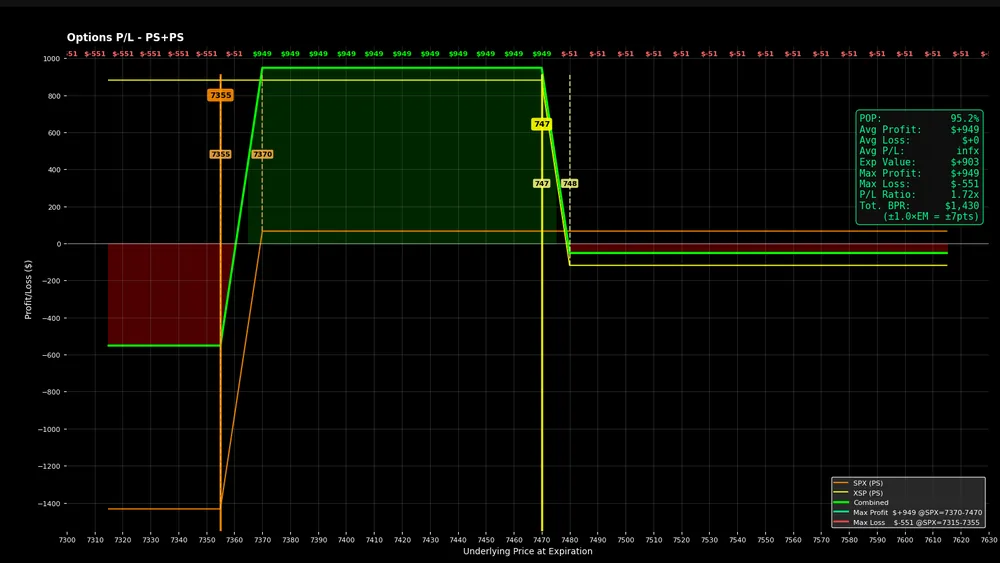
Many traders use both: they put the core position on in SPX and fine-tune it with XSP, for example by hedging an SPX credit spread with a few XSP puts. The catch is that most platforms show each position on its own, in its own units, so it's hard to see what the combination actually does. That's why we built the SPX-XSP Risk Graph Visualizer, a Windows app that scales XSP to SPX terms and draws both positions and their combined profit and loss at expiration on one chart.
Frequently asked questions
How many XSP contracts equal one SPX contract?
Ten. XSP is one tenth the size of SPX, so ten XSP options at the matching strike (the SPX strike divided by 10) give about the same exposure as one SPX option.
Is XSP the same as SPX?
It tracks the same index with the same exercise style, cash settlement and tax treatment, at one tenth of the size. The practical differences are liquidity, cost per dollar of exposure, strike spacing and settlement: all XSP options are PM-settled, while standard monthly SPX options are AM-settled.
Are XSP options taxed like SPX options?
Yes. For US taxpayers both are Section 1256 contracts, taxed 60% long-term and 40% short-term no matter how long you held them. Check with a tax professional about your own situation.
Can XSP options be assigned early?
No. XSP options are European-style, so they can only be exercised at expiration, and they settle in cash rather than shares.
Does XSP have 0DTE options?
Yes. Like SPX, XSP has expirations every weekday, so on any trading day there is an XSP contract that expires that same day.
Is XSP better than SPY?
It depends on what matters to you. XSP can't be assigned early, settles in cash and gets 60/40 tax treatment. SPY options have far more volume and penny-wide spreads. For spreads held to expiration in a taxable account, many traders prefer XSP.
See SPX and XSP on one risk graph
The SPX-XSP Risk Graph Visualizer plots an SPX position, its XSP hedge and the combined profit and loss at expiration on one chart, with probability of profit and expected value.
Sources
- Cboe, SPX Options Product Specifications: contract terms, AM and PM settlement.
- Cboe, XSP Options Product Specifications: contract terms, settlement, strike spacing and trading hours.
- Cboe, Cboe to Further Expand S&P 500 Index Options Suite with New and Additional Daily Expirations (September 2022): daily expirations for SPX and XSP.
- Cboe, Trade Around the Clock with Cboe Global Trading Hours: the overnight session.
- Cboe, trading volume reports for full year 2024 and full year 2025: yearly SPX and XSP volume.
- Cboe, Trading Volume for July 2026 and Derivatives September 2026 Volume Highlights: 2026 XSP volume records and the 0DTE share.
- Cboe, XSP Lead Market Maker Program: incentives for market makers with stricter quoting standards.
- Macroption, Index Options Volume: XSP and SPX average daily volume by year (the chart's data).
- IRS, About Form 6781: Section 1256 contracts and the 60/40 rule.
- IRS, Topic No. 409, Capital Gains and Losses: capital gains tax rates and the net investment income tax.
This article is for education only and isn't financial or tax advice. Options involve substantial risk and aren't suitable for every investor. Contract details can change, so check Cboe's current specifications (listed above) and your broker before trading. See our Risk Disclaimer.