The short answer: an SPX credit spread sells one SPX option and buys a cheaper one further out of the money with the same expiration. You collect a credit up front and keep it if SPX stays on the right side of your short strike, while the option you bought caps your loss. SPX options are cash-settled and European-style, so there's no early assignment or stock delivery, and in the US gains get 60/40 tax treatment.
On this page
- What is an SPX credit spread?
- Example: an SPX put credit spread
- Call credit spreads and iron condors
- Why trade credit spreads on SPX?
- Choosing strikes and width
- Choosing an expiration, including 0DTE
- Managing the trade
- What happens at expiration
- Risks to know
- Taxes
- Smaller account? Use XSP
- Hedging a credit spread with XSP
- Frequently asked questions
What is an SPX credit spread?
A credit spread is two options of the same type and expiration: you sell one closer to the current price and buy one further away. The option you sell is worth more than the one you buy, so you receive a net credit when you open the trade.
- Put credit spread, also called a bull put spread: sell a put below the market and buy a lower put. It profits if SPX stays above the short put, so it suits a neutral to bullish view.
- Call credit spread, also called a bear call spread: sell a call above the market and buy a higher call. It profits if SPX stays below the short call.
- Iron condor: a put credit spread and a call credit spread with the same expiration. It profits if SPX stays between the two short strikes.
The distance between the strikes is the spread's width. Your maximum profit is the credit, and your maximum loss is the width minus the credit, both times $100 per point.
Example: an SPX put credit spread
Suppose SPX is at 7,800 with a week to expiration. You sell the 7,700 put and buy the 7,690 put for a net credit of $2.75, which is $275 per spread.
| Number | How it's worked out | Result |
|---|---|---|
| Max profit | The credit: $2.75 × $100 | $275 |
| Max loss | Width minus credit: (10 − 2.75) × $100 | $725 |
| Breakeven | Short strike minus credit: 7,700 − 2.75 | 7,697.25 |
| Buying power | Usually the max loss | About $725 |
| Return on risk | $275 ÷ $725 | 38% |
| SPX at expiration | What happens | Result |
|---|---|---|
| 7,700 or higher | Both puts expire worthless | +$275 (max profit) |
| 7,697.25 | The short put is worth exactly the credit | $0 (breakeven) |
| 7,695 | The short put is 5 points in the money | −$225 |
| 7,690 or lower | The long put stops further losses | −$725 (max loss) |
Example prices are hypothetical, and the figures are before commissions.
Open this example in our free calculator to see it on a risk graph, with commissions and the probability of profit.
Call credit spreads and iron condors
A call credit spread is the mirror image. With SPX at 7,800, selling the 7,900 call and buying the 7,910 call for, say, $2.70 gives a max profit of $270 if SPX stays below 7,900, a max loss of $730 if it finishes above 7,910, and a breakeven of 7,902.70.
Put the two spreads together and you have an iron condor. You collect both credits, $5.45 or $545 in total, and keep all of it if SPX finishes between 7,700 and 7,900. Only one side can lose at expiration, so the max loss is the width minus the total credit: (10 − 5.45) × $100 = $455. The breakevens move out to 7,694.55 and 7,905.45, and brokers usually hold buying power for one side only.
Why trade credit spreads on SPX?
- No early assignment. SPX options are European-style, so your short option can't be assigned before expiration. With SPY or stock options, a short option can be assigned at any time, especially around dividends.
- Cash settlement. At expiration the spread settles in cash. There's no risk of ending up with shares because one leg was exercised and the other wasn't.
- 60/40 taxes. In the US, SPX options are Section 1256 contracts, so 60% of a gain is taxed at long-term rates however short the trade.
- Daily expirations and deep liquidity. SPX has expirations every weekday and is one of the most actively traded options markets in the world.
- The catch is size. Each SPX point is worth $100 per contract, so even a narrow spread carries hundreds of dollars of risk. XSP offers the same trade at one tenth of the size, covered below.
For a full side-by-side comparison, read SPX vs XSP: differences, taxes and which to trade.
Choosing strikes and width
Most of a credit spread's character comes from how far the short strike is from the current price. Closer strikes collect more but lose more often. Further strikes win more often but collect less and risk more for every dollar they can make.
Traders often use the short option's delta as a guide, because it's roughly the market's estimate of the chance that the option finishes in the money. A short put with a delta of 0.20 has about a 20% chance of ending in the money.
| Put credit spread | Short put delta | Credit | Max loss | Return on risk | Probability of profit |
|---|---|---|---|---|---|
| 7,750 / 7,740 | 0.38 | $3.80 | $620 | 61% | 62% |
| 7,700 / 7,690 | 0.28 | $2.75 | $725 | 38% | 72% |
| 7,650 / 7,640 | 0.19 | $1.85 | $815 | 23% | 81% |
| 7,600 / 7,590 | 0.12 | $1.15 | $885 | 13% | 88% |
SPX at 7,800, 7 days to expiration and 10-point spreads, priced with a simple model that uses 16% implied volatility at every strike, before commissions. Real put spreads usually pay somewhat more, because out-of-the-money puts trade at higher implied volatility (volatility skew).
The pattern holds in real markets too: no strike is both very likely to win and well paid. The furthest spread in the table wins 88% of the time in the model, but it makes $115 when it wins and can lose up to $885 when it doesn't, so it takes almost eight winners to make up for one full loss. Over many trades, the size of the losses matters as much as how often you win.
Another common reference point is the expected move, the one-standard-deviation range implied by option prices. Here it's about ±173 points for the week, so the 7,650 short put sits just inside it and the 7,600 short put outside it. Our calculator shows the expected move for any trade.
Width: wider spreads collect more credit and risk more per spread. Narrow spreads keep the dollar risk small, but commissions take a bigger share of a small credit. On SPX the narrowest common width is 5 points, or $500; on XSP it's 1 point, or $100.
Choosing an expiration, including 0DTE
SPX has expirations every weekday, so you can choose anything from a same-day (0DTE) spread to one that's months out.
- 0DTE and other short-dated spreads lose value quickly as time passes, which works in the seller's favor. But option prices react sharply near expiration, and a move toward your short strike can turn a winner into a max loss within minutes.
- Longer-dated spreads, for example 30 to 45 days out, collect more credit for the same strikes and change value more slowly, which gives you more time to react. They're exposed to more events along the way: economic reports, Fed meetings and overnight gaps.
Whatever you choose, check the calendar. A spread that spans a Fed decision or a jobs report carries more risk than its probability numbers suggest.
Managing the trade
You don't have to hold a credit spread until it expires. Common approaches include:
- Taking profits early. Many traders close a spread once they've captured a set share of the credit, for example half. That gives up some profit and costs a second commission, but it cuts the time the trade is exposed to a sharp move.
- Using a stop. Some traders exit if the loss reaches a multiple of the credit, such as twice the credit, or if SPX trades through the short strike. A fast market can move past a stop before it fills, so it limits losses less precisely than the long option does.
- Rolling. This means closing a threatened spread and opening a new one further out in time or price. It can buy time, but it often means taking on more risk for less credit.
Whichever rules you use, decide them before you enter the trade, and use limit orders. Multi-leg SPX orders can fill far from the midpoint in a fast market.
What happens at expiration
SPX spreads settle in cash automatically, so you don't need to do anything at expiration:
- If SPX finishes on the safe side of your short strike, both options expire worthless and you keep the credit.
- If it finishes between the strikes, the spread settles for the difference. In the example, a settlement of 7,695 costs $500 on the short put, for a net loss of $225 after the $275 credit.
- If it finishes past the long strike, you lose the maximum: the width minus the credit.
Check which settlement your contract uses. Daily and weekly SPX options (root symbol SPXW) settle on the 4:00 p.m. ET closing value. Standard monthly SPX options settle on the opening prices of the S&P 500 stocks on Friday morning, after trading stops on Thursday, so a gap at the open can push the settlement past your strikes with no chance to react. More on AM and PM settlement.
Risks to know
- Losses are bigger than gains. The max loss is usually several times the credit, so one bad week can wipe out many good ones.
- Sudden moves and gaps. The market can fall several percent in a day or open far from the previous close, especially around major news.
- Volatility spikes. When fear rises, option prices jump. A spread can show a large loss before expiration even if SPX hasn't reached your short strike.
- Fills. In a fast market, bid-ask spreads widen and closing a spread can cost much more than expected.
- Concentration. Several spreads on the same side of the market are really one large bet on direction.
Size each position so its maximum loss is an amount you can afford to lose. If you haven't read it, the Options Clearing Corporation's Characteristics and Risks of Standardized Options covers the risks of every options strategy.
Taxes
In the US, SPX options are Section 1256 contracts. 60% of a gain is taxed at long-term rates and 40% at short-term rates however long you held the trade, and positions still open at year-end are taxed as if sold at that day's price. Gains on SPY and stock options held a year or less are taxed entirely at short-term rates. The 60/40 tax comparison in our calculator shows the difference on your own numbers. This is general information, not tax advice, so check with a tax professional about your situation.
Smaller account? Use XSP
XSP (Mini-SPX) options track the same index at one tenth of the size, with the same European-style exercise, cash settlement and 60/40 tax treatment. The XSP version of the example, the 770/769 put spread, would collect about 28 cents ($28) and risk about $72, so you can trade a tenth of an SPX spread or build a position in small steps. The trade-offs are lower liquidity and higher commissions per dollar of exposure, which SPX vs XSP covers in detail.
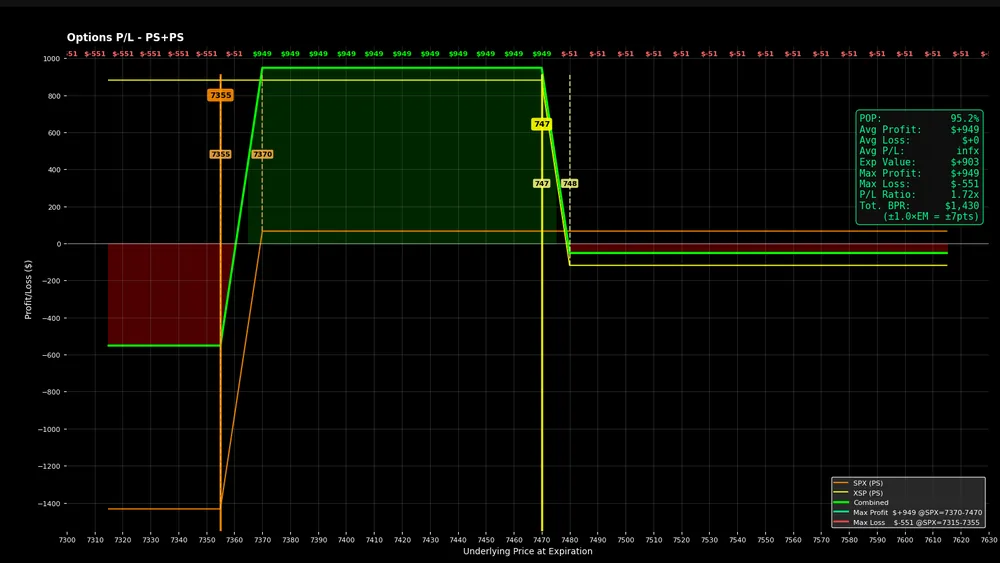
Hedging a credit spread with XSP
Some traders combine the two: they sell the credit spread on SPX and buy a small hedge on XSP, such as a few XSP puts or an XSP put debit spread below the short strike. The hedge costs part of the credit, but it can soften the loss in a sharp drop, and XSP's small size lets you buy just the amount of protection you want.
The hard part is seeing what the combination does, because most platforms show each position on its own. The SPX-XSP Risk Graph Visualizer draws the SPX spread, the XSP hedge and their combined profit and loss at expiration on one chart.
Frequently asked questions
Are SPX credit spreads safe?
No options strategy is safe. A credit spread has a defined maximum loss, but that loss is usually several times the credit, so one bad trade can erase many winners. Size each position so its maximum loss is an amount you can afford to lose.
What happens if SPX expires between my strikes?
The spread settles in cash for the amount the short option is in the money, and you keep the credit you received. In the example, a settlement at 7,695 costs $500 on the short put, for a net loss of $225 after the $275 credit.
Can an SPX credit spread be assigned early?
No. SPX options are European-style, so they can only be exercised at expiration, and they settle in cash rather than shares.
How much buying power does an SPX credit spread need?
Usually the width of the spread minus the credit, times $100, which is also the maximum loss. The 10-point example with a $2.75 credit needs about $725 per spread. Your broker may require more.
Do I have to close an SPX credit spread before expiration?
No. If both options expire out of the money, you keep the credit; otherwise the spread settles in cash automatically. Many traders still close early to lock in a gain or to avoid a last-minute move.
What delta do traders use for the short strike?
There is no single best choice. Lower-delta short strikes win more often but collect less and risk more for each dollar of credit; higher-delta strikes do the opposite. The strike table in this article shows the trade-off.
Try your own SPX credit spread
Enter your strikes and credit in our free calculator to see the max profit and loss, breakevens, probability of profit and a risk graph, in SPX or XSP.
Sources
- Cboe, SPX Options Product Specifications: European-style exercise, cash settlement, AM and PM settlement.
- Cboe, Cboe to Further Expand S&P 500 Index Options Suite with New and Additional Daily Expirations: expirations every weekday.
- Options Clearing Corporation, Characteristics and Risks of Standardized Options: how options and spreads work, and their risks.
- IRS, About Form 6781: Section 1256 contracts and the 60/40 rule.
This article is for education only and isn't financial or tax advice or a recommendation to trade. Example prices are hypothetical. Options involve substantial risk and aren't suitable for every investor. See our Risk Disclaimer.